By Bilal Ahmed
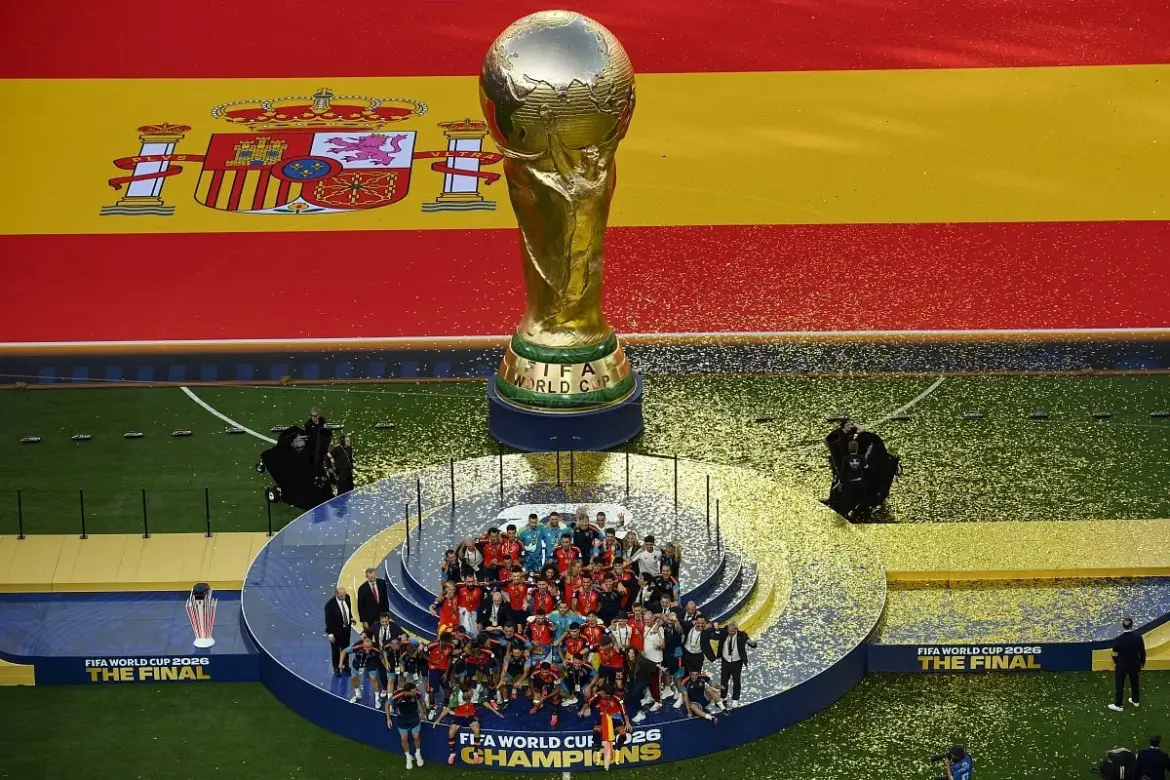
Following the conclusion of the 2026 FIFA World Cup, FIFA has detailed the prize money allocated to participating nations. The tournament, which saw Spain emerge victorious over Argentina in the final match, featured a record-breaking prize fund of $871 million for the expanded 48-team competition. This amount represents an increase of over $100 million from previous tournaments.
Spain, as the champions, received $51 million. Argentina, the runners-up, took home $34 million. The 2026 edition of the World Cup was jointly hosted by the United States, Canada, and Mexico.
Prize Money Structure and Distribution
The prize money for the 2026 World Cup was structured to reward teams based on their performance throughout the competition. Beyond the top two finishers, England, which secured third place, received $30 million, while France, in fourth place, was awarded $28 million. Teams reaching the quarter-finals each received $20 million, and those in the Round of 16 were given $16 million each. Teams that advanced to the Round of 32 received $12 million each, and all teams participating in the group stage were guaranteed $10 million each.
In addition to performance-based prize money, every participating nation received financial support to cover preparation costs. Each federation was guaranteed $12.5 million, which included $10 million for qualifying and competing in the group stage, plus an additional $2.5 million to cover pre-tournament training and associated expenses. This guaranteed payment was implemented to help prevent disputes between players and national federations regarding bonuses before the tournament began.
The decision to increase the prize fund followed requests from several national federations, particularly in Europe. These federations highlighted that the original payment structure might not adequately cover the extensive travel and accommodation costs associated with a tournament hosted across three countries. Furthermore, teams playing matches in the United States faced tax obligations that did not apply in Canada and Mexico, adding to their overall expenses.
FIFA’s Financial Support Beyond Prize Money
Beyond the direct prize money, FIFA also provided comprehensive logistical support for the participating delegations. This included covering business-class return flights for each delegation and providing accommodation and meals for a 50-member delegation. This support commenced five days before a team’s opening match and continued until one day after their elimination from the tournament. FIFA also managed domestic transport during the competition, supplying a fleet of official vehicles and an equipment truck.
However, national federations remained responsible for specific costs, such as insurance for players and staff, incidental hotel expenses, and accommodation for any additional delegation members beyond the allocated 50. The prize money itself is paid directly to each national football federation, not to individual players. The distribution of these funds is then determined by each federation’s internal rules and agreements with its players.
For instance, the United States Soccer Federation retains 20% of its World Cup prize money. The remaining 80% is then divided equally between the men’s and women’s national teams, in line with the country’s equal-pay agreement. The World Cup prize money for Spain, at $51 million, exceeded the $42 million received by Argentina for winning the 2022 World Cup in Qatar.
World Cup vs. Club World Cup Earnings
Despite the significant prize money for the World Cup, the amount received by the champions is notably less than what some clubs earned in the FIFA Club World Cup. For example, Chelsea received up to $125 million for winning the Club World Cup, a tournament that was rebooted into a 32-team format with its first edition in June and July 2025. This difference is attributed to the distinct financial models and cost structures associated with club football compared to national teams.
FIFA‘s explanation for this disparity highlights that clubs incur substantial year-round wage bills, with players often earning multi-million-pound annual salaries. The Club World Cup prize money is set to compensate top clubs for their participation and the disruption to their domestic seasons. National teams, conversely, do not carry the same level of ongoing player salary costs, as players are not typically paid club-level salaries for representing their country.
The World Cup generates significant revenue for FIFA, with the organization on track to generate approximately $13 billion in total revenue across its current four-year commercial cycle through 2026. Roughly $8.9 billion of this is expected to come directly from the 2026 World Cup itself. The prize pool, while substantial, represents a portion of this revenue, with the remainder allocated to tournament operations, FIFA‘s operating costs, and funding football development programs for its 211 member associations worldwide.
The World Cup is viewed by FIFA as a mechanism for redistribution, taking revenue from wealthier football markets and broadcasters and distributing a portion to member nations, regardless of their qualification status. The Club World Cup, being a newer and expanded property, has been structured with higher prize money to attract and legitimize the participation of top clubs like Chelsea, Real Madrid, and Manchester City. The World Cup, with its long-standing prestige, does not require the same financial incentives to ensure participation.
The 2026 World Cup final between Spain and Argentina took place at the New York/New Jersey Stadium in East Rutherford.
Read Also
- New Jersey hosts World Cup final as Trump celebrates US role and eyes future bids
- Italian FA officials meet Pep Guardiola in Barcelona regarding national team role
- Madrid welcomes Spain's World Cup champions after second triumph
- New York New Jersey Stadium hosts celebrity-filled 2026 World Cup final
Source: vanguardngr.com